Premium Street-Legal Electric Golf Carts · Built In Monroe, Wisconsin
- About
- Models +
- Resource +
- Resources
- Find A Dealer
- Become A Dealer
- Warranty
- Contact

Choosing the right 160 Ah Golf Cart Lithium Battery Upgrade requires more than comparing capacity and price. A battery may promise longer rides, yet it must also match the cart’s voltage, charger, motor, tray space, and cable connections. This guide examines those practical details for golf cart owners planning an upgrade in 2026.
Real-world use matters.
A 160 Ah lithium battery can provide useful range for courses, neighborhoods, farms, and utility tasks. However, actual distance depends on passenger weight, hills, tire pressure, driving speed, temperature, and battery age. A reliable evaluation should include the battery management system, continuous output, low-temperature protection, charging behavior, and expected cycle performance. Manufacturer datasheets provide the starting point, but installation experience often reveals overlooked issues, such as loose terminals or insufficient clearance beneath the seat.
The best upgrade is not always the largest battery. Some carts need a compatible charger, a mounting bracket, or updated wiring before they can operate safely. Buyers should confirm warranty coverage, technical support, water resistance, and service procedures before purchasing. It is also wise to measure the battery compartment with a tape measure, rather than trusting a product photograph. That small step can prevent an expensive return.
This guide compares important specifications, installation concerns, operating habits, and ownership costs. It also questions common marketing claims. Capacity alone does not guarantee better performance. Careful matching does.
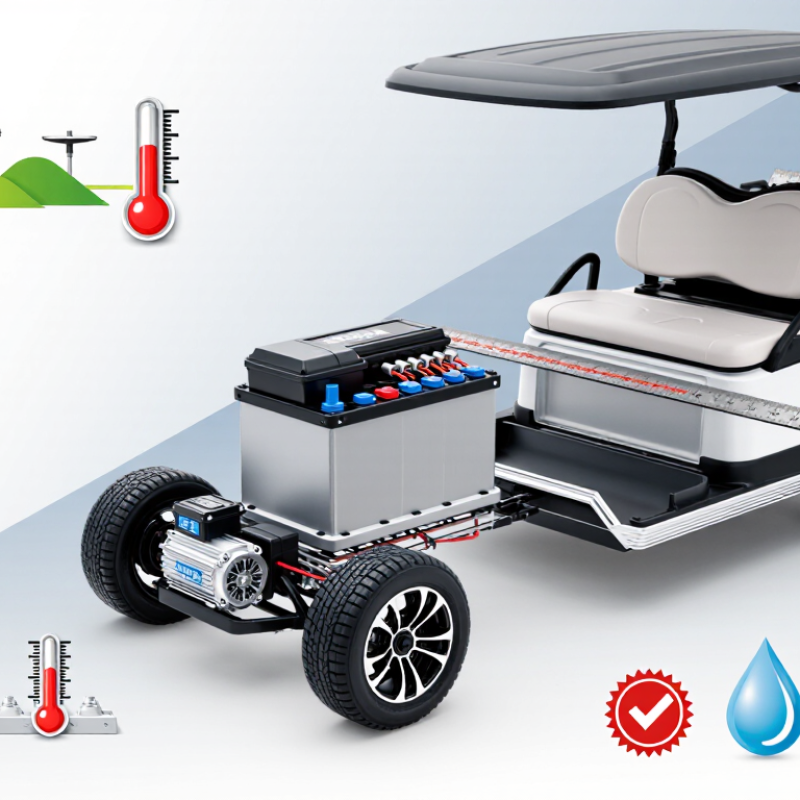
A 160 Ah lithium battery can store substantial energy, but its voltage matters just as much. A 51.2 V, 160 Ah pack provides about 8.2 kWh under ideal conditions. A 48 V golf cart may accept this voltage range, but every vehicle needs verification. Older carts may use 36 V systems, while some newer models use 72 V architecture. Voltage mismatch can damage electrical components or prevent normal operation.
Capacity is only half the story. Check the battery compartment’s length, width, and height before ordering. Measure the tray, cables, and nearby controller space. The battery management system should support the cart’s continuous and peak current demands. Heavy carts, steep hills, passengers, and towing require higher output. A 160 Ah rating does not guarantee longer range in every situation. Tire pressure, driving speed, temperature, and terrain can change results noticeably. Fit matters.
The charger must match the battery’s lithium chemistry and voltage profile. Using an unsuitable charger may create overheating or charging faults. Confirm connector polarity, cable size, fuse protection, and communication requirements. A qualified technician should inspect these details before installation. In practical use, lithium batteries often maintain stronger voltage under load than lead-acid units, yet cold weather can reduce available power. Charging below the manufacturer’s permitted temperature may also be unsafe. The 160 Ah label sounds decisive, but it deserves careful questioning.
| Data Dimension | 160 Ah Lithium Battery Information | Why It Matters for a Golf Cart | Compatibility or Selection Check |
|---|---|---|---|
| Rated Capacity | 160 Ah, measured at the battery's specified discharge conditions. | Capacity indicates how much electric charge the battery can theoretically deliver. Actual usable energy depends on voltage, temperature, load, battery-management-system limits, and the selected reserve. | Confirm that the 160 Ah rating is stated at a clearly defined test temperature, discharge current, and cutoff voltage. |
| Energy at 25.6 V Nominal | 4.096 kWh 25.6 V × 160 Ah = 4,096 Wh |
Typically suited to systems designed around 24 V nominal battery voltage, subject to the cart's motor controller and charger requirements. | Do not install in a 36 V, 48 V, or 72 V system unless the complete electrical system is specifically designed for that voltage. |
| Energy at 38.4 V Nominal | 6.144 kWh 38.4 V × 160 Ah = 6,144 Wh |
Can be relevant to carts engineered around a 36 V nominal lithium configuration. | Verify controller voltage range, charger output, contactor rating, and low-voltage protection settings. |
| Energy at 48 V Nominal | 7.68 kWh 48 V × 160 Ah = 7,680 Wh |
Commonly considered for 48 V golf-cart platforms. The higher energy reserve can support longer operation than a smaller-capacity pack at the same voltage. | The battery must match the cart's nominal voltage and provide sufficient continuous and peak current for the motor controller. |
| Energy at 51.2 V Nominal | 8.192 kWh 51.2 V × 160 Ah = 8,192 Wh |
A 51.2 V lithium iron phosphate configuration is commonly used as a 16-series-cell lithium system and is often marketed for 48 V applications. | Use only when the battery documentation confirms compatibility with the cart's 48 V electrical system, charger, controller, and accessories. |
| Energy at 72 V Nominal | 11.52 kWh 72 V × 160 Ah = 11,520 Wh |
Applicable to selected high-voltage carts and utility vehicles rather than standard low-voltage golf-cart systems. | Requires a complete 72 V-rated system, including the controller, charger, DC-DC converter, cables, contactor, and safety equipment. |
| Approximate Usable Energy | Usable energy is normally below the calculated nominal energy. For example, at 90% usable depth of discharge, a 51.2 V, 160 Ah pack provides approximately 7.37 kWh. | Keeping a reserve can improve battery life and help prevent unexpected shutdowns under heavy load. | Use the battery-management-system specifications rather than assuming the full 160 Ah is available in every operating condition. |
| Estimated Driving Range | Range varies widely. As an illustration, an 8.192 kWh nominal pack delivering about 7.37 kWh usable energy could provide approximately 24.6 to 36.8 miles at an estimated 200 to 300 Wh per mile. | Terrain, passenger and cargo weight, tire pressure, speed, acceleration, temperature, and driving style can change energy consumption substantially. | Treat range figures as planning estimates, not guaranteed performance. Measure consumption on the intended route when possible. |
| Battery Chemistry | Lithium iron phosphate, commonly abbreviated as LiFePO4, is widely selected for traction applications because of its thermal stability and long cycle-life potential. | Chemistry affects voltage profile, charging requirements, weight, safety behavior, and service life. | Confirm the chemistry, cell configuration, operating temperature limits, and charging profile in the technical documentation. |
| Nominal Voltage Matching | The battery's nominal voltage must match the intended electrical architecture; amp-hour capacity alone does not determine compatibility. | A 160 Ah battery at 48 V is not interchangeable with a 160 Ah battery at 72 V. | Match battery voltage with the motor controller, charger, contactor, DC-DC converter, display, and other connected components. |
| Continuous Discharge Current | The required value depends on motor power and operating conditions. For reference, a 5 kW motor at 48 V draws about 104 A at ideal electrical efficiency before real-world losses. | Insufficient continuous current can cause voltage sag, reduced performance, or battery-management-system protection trips. | Compare the battery's continuous discharge rating with the controller's maximum battery current, not only the motor's nominal power. |
| Peak Discharge Current | Short-duration peak current is used during acceleration, hill climbing, or heavy loads and is normally higher than continuous current. | Adequate peak capability helps maintain acceleration and reduces nuisance protection events. | Check the peak-current duration, recovery time, and protection threshold stated by the battery manufacturer. |
| Charging Voltage | Charging voltage is determined by the lithium chemistry and series-cell configuration. It is not selected solely from the 160 Ah rating. | An incorrect charger can undercharge the pack, trigger protection, or create a serious safety risk. | Use a charger specifically programmed for the battery chemistry and nominal voltage. Do not use a lead-acid charger unless expressly approved for the lithium battery. |
| Battery Management System | A suitable BMS should monitor cell voltage, pack voltage, current, and temperature while providing overcharge, over-discharge, over-current, short-circuit, and thermal protection. | The BMS is a key part of safe operation and determines how the battery responds to abnormal conditions. | Confirm the BMS continuous and peak current ratings, low-temperature charge protection, communication features, and reset behavior. |
| Low-Temperature Charging | Many lithium iron phosphate batteries should not be charged below 0°C unless they include an approved low-temperature charging solution. | Charging cold lithium cells can cause permanent cell damage. | Look for low-temperature charge cutoff, internal heating, or a clearly specified minimum charging temperature. |
| Physical Fit | Pack dimensions, terminal position, mounting points, enclosure shape, and cable routing vary even when capacity and voltage are identical. | A physically unsuitable battery can shift during driving, interfere with the seat or enclosure, or create cable and terminal hazards. | Measure the battery compartment before purchase and verify length, width, height, weight, mounting method, and terminal clearance. |
| Weight Consideration | Lithium packs are generally lighter than equivalent lead-acid banks, but the actual weight depends on cell design, enclosure, BMS, and accessories. | Lower mass can reduce suspension load and may improve efficiency, but weight distribution still affects handling. | Check the cart's axle, suspension, and payload limits after accounting for passengers, cargo, charger, and accessories. |
| Wiring and Protection | Use correctly sized cables, secure terminals, appropriate fusing or circuit protection, and insulated connections rated for the system voltage and current. | High-current traction systems can generate dangerous heat and arcing if wiring is undersized or poorly secured. | Follow the battery and cart service instructions. Disconnect the battery before electrical work and protect terminals from accidental short circuits. |
| Best-Fit Application | A 160 Ah lithium battery is best suited to a cart or utility vehicle whose voltage, current demand, charger, physical space, and control electronics are all compatible. | Large capacity alone does not guarantee longer range or better performance if the rest of the system is mismatched. | Complete a voltage, current, charger, BMS, dimensions, mounting, and accessory compatibility review before upgrading. |
| Important Safety Note | Battery installation should follow the vehicle and battery documentation and, where required, be completed or inspected by a qualified technician. Nominal energy calculations are theoretical: Energy (Wh) = Voltage (V) × Capacity (Ah). Actual results vary with load, temperature, battery age, and system efficiency. | ||
At 48 volts, it stores about 7.68 kilowatt-hours nominally. At 72 volts, it stores about 11.52 kilowatt-hours. Usable energy will be lower.
Not necessarily. A lightly loaded cart may manage short trips comfortably. Long hills, towing, passengers, and accessories can reduce range quickly.
Check system voltage, motor rating, controller limits, and management-system output together. Also inspect cable size, charger compatibility, battery weight, and enclosure ventilation.
Steep hills demand more power and can cause noticeable voltage sag. Record voltage during climbs, not only on flat pavement. Flat-road testing can mislead.
Use a charger matched to the battery’s chemistry and voltage. Let the battery cool after demanding climbs. Avoid leaving unfamiliar charging equipment connected overnight.
Park it in a shaded, ventilated area. Follow the recommended storage charge level. Check the battery periodically, because a nearly empty battery may suffer unnecessary stress.
Watch for reduced range, unusual heat, swelling, odor, fault codes, or charging changes. Low tire pressure and heavy loads can imitate battery failure. The battery is not always responsible.
No. Record resting voltage, charging time, travel distance, and temperature changes. A handheld meter may reveal useful trends, if used correctly. I would treat readings as clues, not perfect proof.
It is convenient, but repeated heat buildup deserves attention. Compare temperature and charging behavior before changing settings. My earlier assumption might be wrong.
Seek qualified service for persistent overheating, swelling, odor, fault codes, or damaged sealed modules. Do not bypass protective controls or open sealed battery sections. Safety matters more than curiosity.
The 2026 Top 160 Ah Golf Cart Lithium Battery Upgrade Guide explains how to evaluate whether a 160 Ah lithium battery is suitable for your golf cart and driving habits. It covers usable capacity, voltage compatibility, expected range, terrain, passenger load, accessories, and power demands before making an upgrade. The guide also compares key battery chemistry options and highlights the importance of a properly rated battery management system (BMS), built-in protection, temperature monitoring, and safe operating features.
It also provides practical guidance for installing and configuring a 160 Ah Golf Cart Lithium Battery Upgrade, including checking connections, securing the battery, confirming charger compatibility, and following electrical safety procedures. To support long-term performance, readers will learn how to charge the battery correctly, avoid excessive discharge or extended storage at extreme charge levels, monitor voltage and temperature, and perform regular inspections. These steps can help improve reliability, efficiency, service life, and overall golf cart performance.